The Industry Standard
Why Your
Royalty Statement Matters
If you're thinking about selling, you might wonder why a buyer needs your royalty statement. Here's what it does, why it's safe to share, and why it's actually in your best interest.
The Statement, Not the Check
To be clear: we're not asking for a copy of your check. We're asking for the royalty statement (sometimes called a check stub or check detail) that accompanies your royalty payment.
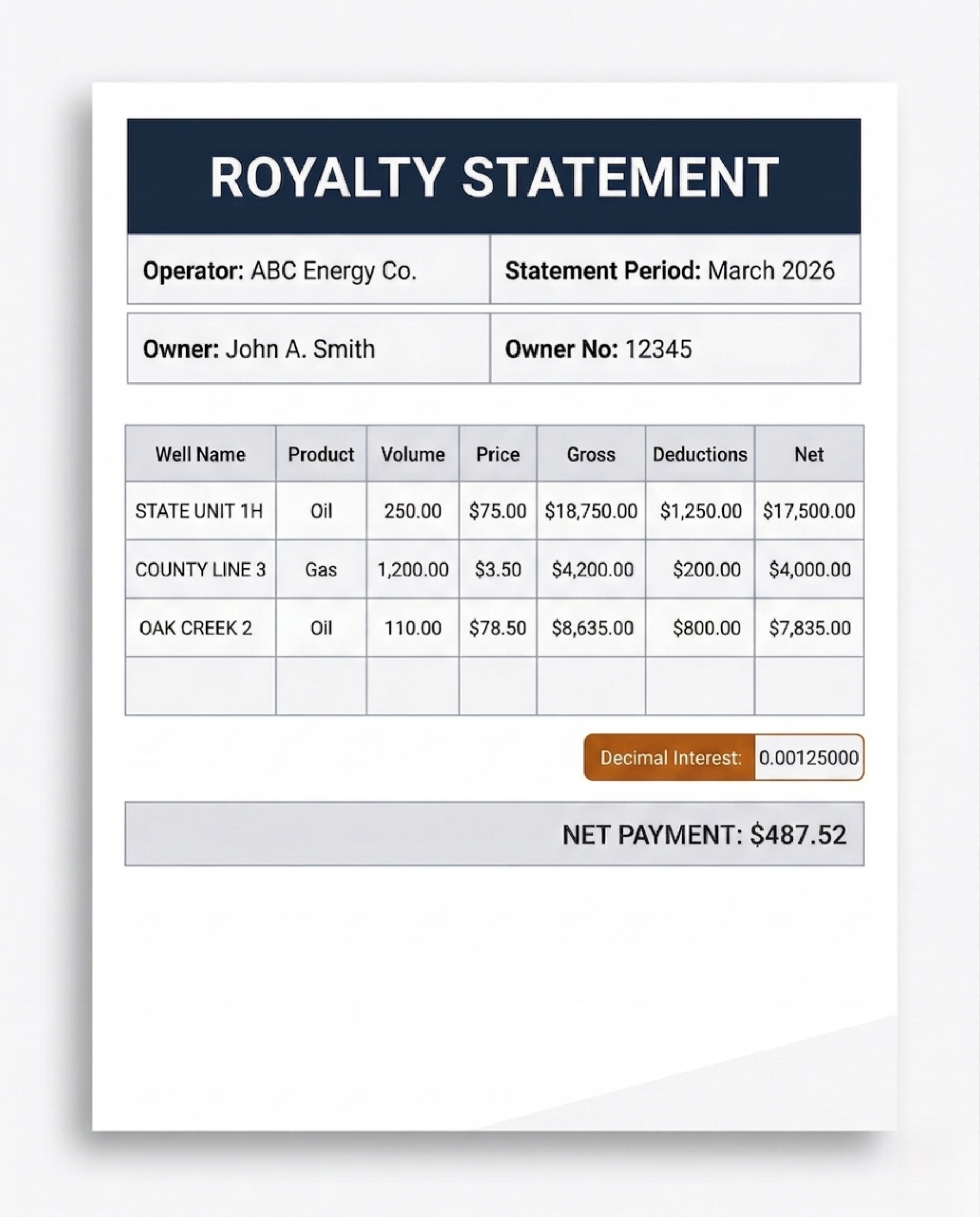
The statement is the document that contains the critical data we need to evaluate your mineral interest. It includes:
- Production volumes: how much oil or gas was produced from your wells
- Commodity prices: the price per barrel or per MCF used to calculate your payment
- Royalty decimal (net revenue interest): your ownership share of production
- Operator and lease name: identifies who is operating and where
- Well information: which wells are producing on your interest
- Deductions: taxes, post-production costs, and other deductions applied to your royalty
This is the information that allows any buyer to calculate what your minerals are actually worth. Without it, any offer is a guess.
It's the Industry Standard
Every professional mineral buyer, broker, and acquisition firm in the industry asks for royalty statements. It is the standard first step in any mineral rights transaction, and not just when companies are buying. When individual mineral owners buy and sell interests from each other privately, the royalty statement is still the first document that changes hands. This isn't unique to us. It's how the entire industry operates, at every level.
Think of it this way:
- You wouldn't sell a house without an appraisal.
- You wouldn't sell a car without a Carfax or maintenance records.
- You wouldn't sell a business without financial statements.
A royalty statement is the equivalent for mineral rights. It's the foundational document that makes an informed, fair transaction possible.
A buyer who doesn't ask for your statement is either guessing at your value (which usually means a lowball offer) or isn't a serious buyer.
Why It Matters
Your royalty statement does what a back-and-forth email exchange never could.
Accurate Valuation
Production data, pricing, and your royalty decimal are the inputs to any credible valuation. Without them, any offer is just a guess, and guesses tend to be lowball offers.
Identifies Your Property
The statement tells us the operator, lease name, well names, and county. Everything needed to identify exactly what you own.
Reveals Production Trends
A single statement is a snapshot. Two or three statements show the trend: whether production is stable, declining, or growing. That trend directly affects the value of your interest and the accuracy of your offer. The more statements you provide, the more precise the valuation.
Verifies Ownership
Your royalty decimal on the statement confirms your ownership interest. It's a first step in verifying that you own what you're selling.
Signals Serious Intent
Submitting a statement tells us you're genuinely interested in exploring a sale. It lets us prioritize your inquiry and respond with a real offer, not a form letter.
Get an Answer Faster
Instead of a lengthy back-and-forth gathering information you may not know off the top of your head, your statement has it all in one document. Faster for you, faster for us.
Why Can't the Buyer Just Look This Up?
A common reaction from mineral owners is: "Why should I do your work for you? Can't you just look this up?"
It's a fair question. And the short answer is: some of this data exists in public records, but much of it doesn't. What does exist is expensive, incomplete, and often months out of date.
State oil and gas commissions publish production data, but there's typically a 3-6 month lag between when production occurs and when it appears in public records. Your royalty statement reflects current production, the most recent month, which public databases simply don't have yet.
Beyond timing, your statement contains information that isn't available in public records at all:
- Your exact net revenue interest (decimal): public records may show a lease, but not how your specific ownership share was calculated after pooling, unitization, and division orders
- Post-production deductions: gathering, compression, transportation, and processing costs vary by operator and by lease. These aren't published anywhere.
- Actual prices received: operators sell production at wellhead prices that differ from NYMEX spot prices due to basis differentials, contract terms, and quality adjustments. Only your statement shows what was actually paid.
- Pooling and allocation adjustments: production may be reported one way to the state and allocated differently to owners based on pooling agreements. Your statement reflects your actual allocation.
Compiling even a partial version of this information from public sources requires accessing state databases, purchasing production reports, researching county records, and cross-referencing multiple data sources. It takes significant time and money, and it still won't be as accurate or current as your single royalty statement.
Your statement isn't "doing our work for us." It's providing the one document that gives us everything we need to make you a fair, informed offer rather than a rough guess based on incomplete public data. That distinction is the difference between a serious offer and a lowball one.
What Your Statement Does NOT Contain
We understand the hesitation. Sharing any financial document can feel uncomfortable. But a royalty statement is not a sensitive financial document in the way a bank statement or tax return is. Here's what it does not include:
- No Social Security number
- No bank account or routing numbers
- No credit card or payment information
- No personal financial data
A royalty statement contains production data and payment calculations, the same type of information that is largely available through public records at state oil and gas commissions. The check itself has already cleared. The statement is simply the detail behind it.
Sharing a royalty statement is no different than sharing a property tax statement or a utility bill. It tells the reader about the asset, not about your personal finances.
Ready to Get an Offer?
Upload your royalty statement and you'll receive a fair cash offer, typically within 48 hours. No obligation, no cost.